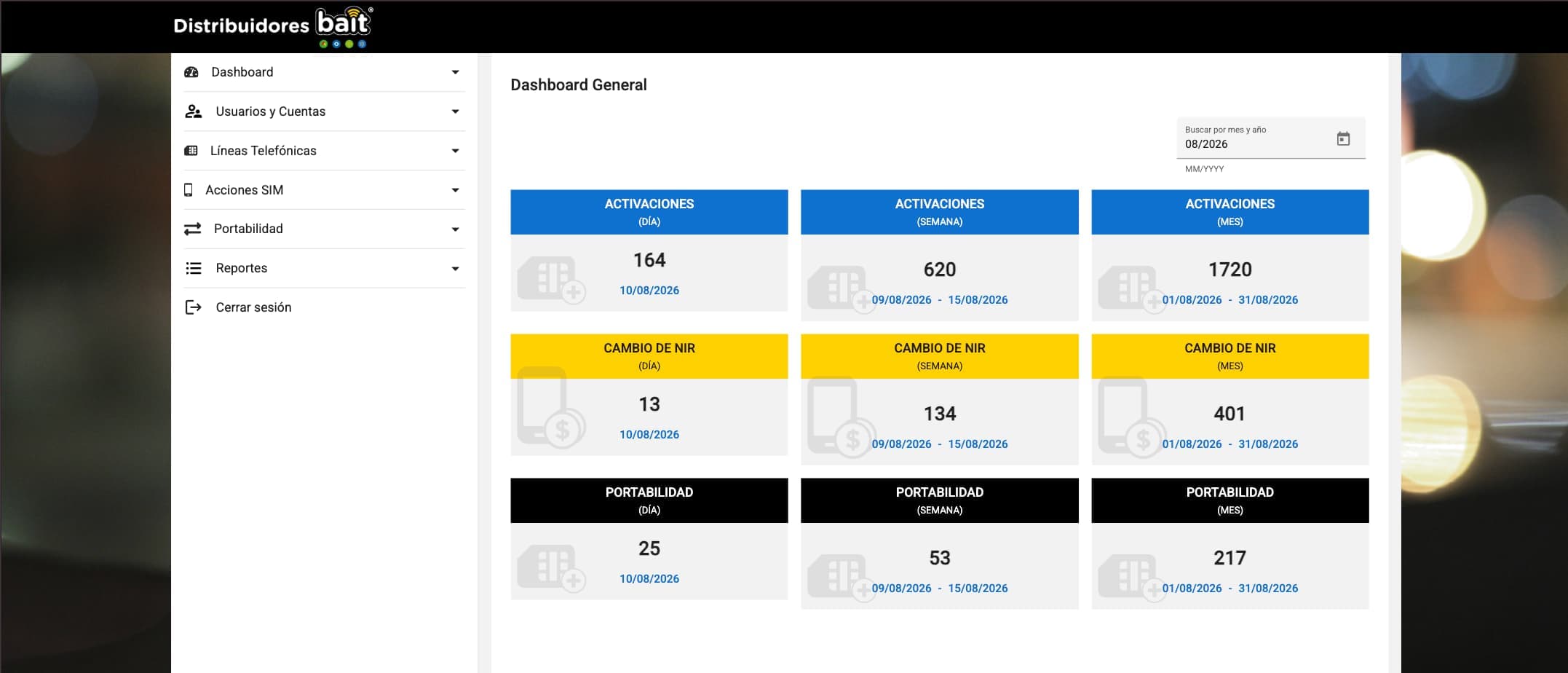
Bait is the MVNO that Walmart de México runs on top of a leased network. In 2022, at Innovattia, I built the frontend of the portal its distribution channel used to move SIM inventory and operate on lines; the work that until then meant filing a request back to the operator and waiting.
A chain, not a user base
The thing that shapes this product is that its users aren't peers. A distributor receives SIM stock and splits it among subdistributors; they hand it to the people standing behind a counter. Above the chain sits an administrator who decides which companies get to enter it at all. Beside it sits support, who needs to answer what happened to this SIM without being able to touch anything.
Five roles, largely the same screens. A distributor opening the accounts section sees its subdistributors; a subdistributor sees its own users; the screen is the same screen. And a SIM isn't one identifier but three (ICCID, MSISDN and IMSI, a tripleta) arriving in batch files of thousands.
So the portal had two problems stacked on each other. The obvious one is inventory: get stock in, split it, track where each SIM went. The one that actually drove the architecture is that every screen had to answer "who is asking" before it could answer anything else.
Permissions as the backbone
The decision that everything else hangs from: the backend returns the menu as the
permission model. One payload carries sections, their routes, and an escritura flag per
section, and three independent consumers read it.
The sidebar renders it, so navigation is whatever the server says it is. A dedicated permission guard authorizes against it on both hooks: once to permit loading a lazy feature module, again to permit activating a route inside it, though how thoroughly it does the second is something I come back to. And a helper matches the current router URL back against the same tree to decide whether a screen's write controls render at all, so a read-only user doesn't get a disabled Save button, they get a screen with no Save button.
The payoff is that adding a section is a backend change. The client has no hardcoded list of what exists or who may see it; it discovers both at sign-in.
The cost is a coupling that isn't obvious from any one file. The tree's paths have to match the router's paths exactly, because the guard compares strings, and that agreement is enforced nowhere. Three files have to stay in step with a payload none of them owns. I'll come back to what that cost me four years later.
Making invalid states unsubmittable
The operations here aren't CRUD. Activating a line, changing its area code, porting a number in from another carrier: these are carrier transactions with preconditions, and they fail server-side in ways that are slow and unhelpful to explain after the fact.
Activation is the clearest case. A line can't be activated on a device the network won't accept, so the screen resolves compatibility first: the operator enters the IMEI, the portal answers whether the handset is supported, on which bands, with VoLTE or without. Only then does the offer selector unlock, and only then will the form submit. The preconditions aren't validated at submit time; they gate the controls that would let you submit at all.
The same instinct runs through the rest. Portability collects the subscriber's NIP and CURP with format validation before it will accept a request. Area-code change resolves against a NIR catalog rather than a free text field. Batch inventory is parsed in the browser into tripleta rows and shown in a table where the operator prunes bad ones before anything is committed. The file isn't uploaded and then reconciled, it's read, reviewed, and only then posted.
Underneath, every list in the app is one shape. The twelve paginated tables each merge
their sort header, paginator and a debounced search emitter into a single stream, start it
with an empty event to trigger the first load, and switchMap into the endpoint so an
in-flight request is abandoned the moment the user types another character. Sorting,
paging and searching all resolve server-side; no component holds request state of its own.
Twelve screens, one behaviour, and no chance of a stale response overwriting a fresh one.
When something fails
Components in this codebase don't branch on failure. They throw.
There's a small family of typed error classes (a request failure, an invalid session, a missing field), each carrying its own title, icon and message, and a global handler renders them. Beside it an HTTP interceptor watches every response for a 401 and for the API's custom 512–518 session codes: account expired, credentials expired, account disabled, no role assigned, account blocked. Each maps to its own sentence, and the session teardown happens in one place rather than in every subscriber.
The reason to keep those five codes distinct instead of collapsing them into please sign in again is that this is an internal tool. The person hitting the error is the person who will report it, often to me. "Your account has no role assigned" ends in a fix. "Something went wrong" ends in a meeting.
The visible effect is that a screen's happy path reads start to finish. No error plumbing threaded between the steps that do the work.
Revisiting it in 2026
To show this work without exposing company data, I stood the app back up against a mock
backend. Angular gave me a cleaner seam than I expected: an HttpInterceptor sits in the
same chain as the app's own error interceptor, matches the outgoing URL, and answers it.
Not one component or service changed. The fake data enters through exactly the pipe
the real data used.
The work wasn't writing fixtures, it was recovering the contracts. There was no schema to
read from, so each response shape had to be derived from the far end, from how components
destructure and iterate what they receive. A list screen tells you it wants
{ success, total, lista } because that's what its pipeline maps. A detail screen tells
you its nesting because the template reaches four levels down into it.
The permission tree was the hard part, and for a reason the architecture predicted. Getting
it wrong doesn't produce an error; it produces an app that quietly refuses. A path that
doesn't match sends you back to the root with no explanation; an escritura flag in the
wrong place renders a screen with its actions silently missing. I had to satisfy all three
consumers at once before a single screen behaved, which is the coupling I described above,
felt from the outside.
Running the whole thing end to end surfaced three things worth naming:
-
The dashboard queries while you type. The landing screen summarises a period in cards, and it re-runs that query on the end-date field's change event. Picking the dates from the calendar fires it once. Typing them fires it repeatedly, against half-parsed values, because the input reformats as characters arrive. Nobody typed the dates, so nobody saw it.
-
Route protection leans on load order.
AuthGuardchecks the session incanLoad, the hook that permits loading a feature module; itscanActivate, the hook that permits activating a route inside that module, returns true unconditionally. Since the app restores its session from storage before routing, the gap never opened in practice. It's only visible once the module is already loaded and the session isn't. -
The build no longer builds.
momentis imported directly by a component but was never declared as a dependency. It had been arriving as a transitive peer, and the day that stopped being true it stopped compiling. The spreadsheet parser points at a latest archive URL whose contents have since changed, so the lockfile's integrity hash no longer matches anything. Neither was wrong in 2022. Both are the same lesson about what "pinned" actually means.
The first two depend on timing and ordering, conditions the original environment happened to satisfy. The third depended on nothing but time passing. That's the pattern: the defects that survive are the ones whose symptoms need a circumstance you don't control.
What I would do differently
The error handler swallows real exceptions. Its first branch returns early for
anything that is instanceof Error. That only works because the custom error classes
implement the Error interface rather than extending it, so they aren't instances,
they fall past the guard, and they get rendered. Everything else takes the early return.
A TypeError on an undefined field disappears without a console line. The custom types
should have extended Error and been discriminated on their name, leaving the fallback
to actually report instead of to hide.
The permission tree deserved a contract. Three consumers agreeing on paths by string
comparison, with the paths themselves owned by a server payload, is a lot of trust placed
in nothing, and the guard doing the comparing reads URL segments positionally. One segment
is matched against the menu; two are checked only when the second is registro; anything
else is waved through. That is enough to let a route like gestion-usuarios/:uuid activate
with no permission check at all, which is a hole rather than an untidiness. A single module
that parses the tree once, validates it against the router's own configuration, and exposes
typed queries (can I see this, can I write here) would have turned both the silent
misroute and the silent bypass into a startup error. The design was right; it was missing
the one place that owned it.
One character of type erasure. The pagination interface declares its search field as
the empty-string literal type rather than string. Assigning a real search term should
not compile. It does, because the value arrives from an any-typed DOM event and nothing
along that path ever asked. Small bug, general lesson: any at the boundary voids the
guarantees everywhere downstream, and a type that was meant to document the contract ends
up documenting nothing at all.