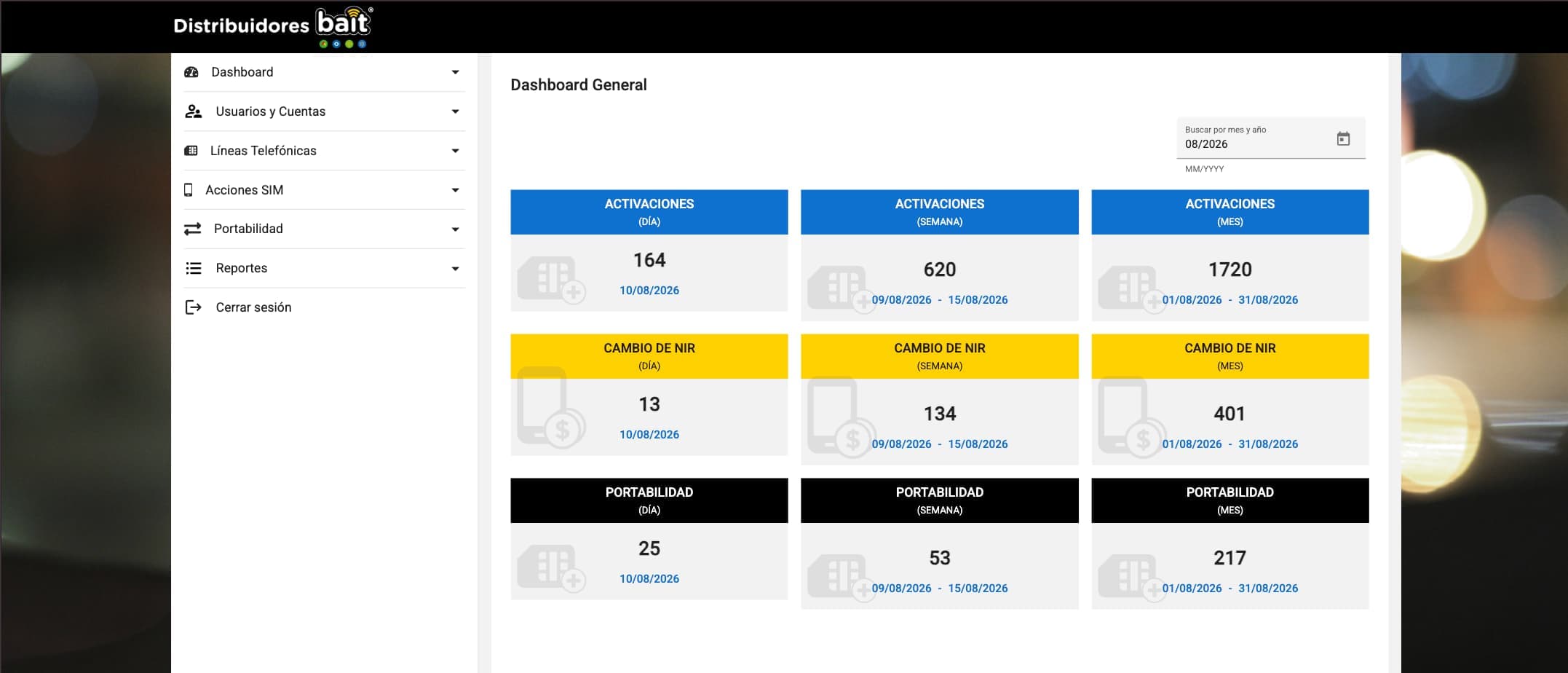
On the visuals in this page. The walkthrough below was recorded from a local demo build whose HTTP layer is intercepted and answered with fictional, generated data. No real customer, commercial or operational information from the company is shown, no backend is reachable, and the source repository is not published. What I share here are visual renders only, for the purpose of documenting my own work.
Walmart de México sells mobile service as Bait, and not directly: SIM stock travels down a chain of resellers before it reaches anyone's hands. At Innovattia I built the frontend of the portal that chain used to move that inventory and to act on the lines themselves; operations that, before it existed, each meant a ticket back to the operator.
The problem
Bait sells through a tiered channel: a distributor receives SIM stock, splits it among subdistributors, and they in turn hand it to the people behind a counter. A SIM is not one identifier but three (ICCID, MSISDN and IMSI, a tripleta) and stock arrives as batch files of thousands of them.
Two things made this awkward to build. First, every level of the chain sees a different portal: the same screen has to show a distributor its subdistributors and show a subdistributor its own users, with write access granted section by section. Second, the operations aren't CRUD: activating a line, changing its area code, porting a number in from another carrier are carrier transactions with preconditions. A line can't be activated on a device the network won't accept, so compatibility has to be resolved before the activation form will even submit.
What I built
A console over the SIM lifecycle, shaped by whoever is signed in:
- Dashboard: the landing screen, summarising the account's activation and movement counters for a period in a row of cards, the range set from a date picker. Read-only and visual; nothing here is exported.
- Inventory: batch files parsed in the browser into tripleta rows, reviewed and pruned in a table before anything is committed, then assigned whole or SIM by SIM to an account further down the chain.
- Operations on the line: activation gated behind an IMEI compatibility check (band 28, VoLTE) and an offer selection that previews data, minutes, SMS and validity; area-code change against a NIR catalog; port-in collecting NIP and CURP from the subscriber.
- Accounts and permissions: subdistributors and users, each with a permission matrix where read and write toggle independently per section.
Two roles sit outside the chain: an administrator who reviews the documentation of incoming distributor applications through a four-step validation flow, and a support role that traces the complete movement history of a single SIM (activation, area-code change, portability) on one timeline.
Technical notes
Permissions are one tree, read by three consumers. The backend returns the menu as
the permission model: sections, paths, and an escritura flag per section. The sidebar
renders it, a route guard authorizes lazy-module loads and route activations against it,
and a helper matches the current router URL back to it to decide whether write controls
render at all. Navigation, authorization and UI affordances come from a single payload,
so a new section is a backend change and the client follows.
Failures are thrown, not handled at the call site. Components don't branch on errors.
They throw typed classes (ErrorRequest, ErrorInvalidSession, ErrorEmptyParam),
each carrying its own title, icon and message, and a global ErrorHandler renders them.
Beside it an HTTP interceptor watches for 401 and the API's custom 512–518 session codes
(expired account, expired credentials, disabled, no role assigned, blocked) and tears the
session down centrally. The effect is that a screen's happy path reads start to finish
without error plumbing threaded through it.
Every table is the same stream. The twelve paginated lists share one RxJS shape: a
merge of the sort header, the paginator and a debounced search emitter, startWith({})
to trigger the first load, then switchMap into the endpoint so an in-flight request is
abandoned the moment the user types again. Sorting, paging and search all resolve
server-side; the component holds no request state of its own.
What I would do differently
The global error handler swallows real exceptions. Its first branch is
if (error instanceof Error) return;, and the only reason the custom error classes reach
the renderer is that they implement the Error interface instead of extending it. So
every genuine runtime exception takes that early return and disappears without a console
line.
Authorization is thinner than it looks. AuthGuard.canActivate returns true
unconditionally; only canLoad checks the session, so protection leans on a module not
having been loaded yet. The permission guard has its own version of the same problem,
matching URL segments positionally and leaving whole shapes of route unchecked. Neither
is expensive to fix and neither should have shipped that way.
One character of type erasure. IPaginador declares buscar: "", the empty-string
literal type rather than string, so assigning a real search term should be a compile error.
It isn't, because the value arrives from an any-typed DOM event and nothing along that
path ever asked. any at the boundary quietly voids the guarantees everywhere downstream.